Why Doesn’t My Ciabatta Have Large Holes?
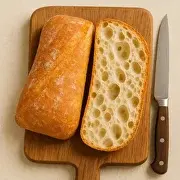
You cut into a freshly baked ciabatta expecting the dramatic, irregular holes that make this bread so recognizable. Instead, the crumb is soft and pleasant but filled with small, even pores.
The first thought is often to add more water next time. Ciabatta is a high-hydration bread, so it seems logical that wetter dough should create larger holes. But open crumb does not come from water alone. It develops when the dough produces enough gas, builds a gluten network capable of holding it, and reaches the oven without losing its internal structure.
The size of the holes is only the final result of everything that happened before baking.
Large Holes Begin During Fermentation
The open structure of ciabatta begins forming long before the dough is divided into loaves.
During bulk fermentation, yeast produces carbon dioxide. The gas stretches the gluten network and creates bubbles throughout the dough. As fermentation continues, some bubbles grow, others join together, and the crumb becomes increasingly irregular.
If bulk fermentation ends too early, the dough has not produced enough gas. It may feel smooth and strong, but it remains heavy and tight. After baking, the crumb usually contains many small, evenly distributed pores.
Watch the dough instead of relying only on the time stated in the recipe. Properly fermented ciabatta dough should rise noticeably—often by approximately 50–70%—and show bubbles along the sides and bottom of the container. Its surface may become slightly domed, and the whole mass should jiggle gently when the container is moved.
The dough should feel lighter than it did after mixing. If it still feels dense, firm, and reluctant to stretch, it probably needs more fermentation.
The Poolish Must Be Ready
When ciabatta is made with poolish, the condition of the preferment affects the entire dough.
A mature poolish is expanded and filled with bubbles. Its surface may still be slightly rounded or may have just begun to flatten in the center. It should smell pleasantly yeasty and fermented, without a harsh alcoholic odor.
If the poolish is used too early, the yeast may not yet be active enough to raise the final dough efficiently. Fermentation will be slower, and following the recipe’s timing exactly may leave the dough underfermented.
A poolish that has stood too long can also lose strength. Once it has completely collapsed and become very thin, it has passed its most active stage. It can still be used, but the final dough may need more time, and its gluten structure may be more difficult to control.
Temperature changes poolish timing considerably. In a warm kitchen, it can mature several hours earlier than expected. Its appearance and aroma are more reliable than the clock.
Water Helps Only When the Dough Can Hold It
Higher hydration makes the dough more extensible and gives the bubbles room to expand. However, adding more water does not guarantee large holes.
If the flour cannot absorb and support the water, the dough becomes loose without becoming strong. It spreads across the table, sticks heavily, and loses gas during dividing and transferring. The baked ciabatta may be wide and flat, with a damp or compressed crumb rather than an open one.
A well-developed dough at 75% hydration will usually create a better crumb than weak, shapeless dough at 80%.
Flour behaves differently from one kitchen to another. Even two bread flours with a similar protein percentage may not absorb the same amount of water. If the dough never gains strength during folding, hold back some of the water at the beginning of mixing. Add it gradually only if the dough can accept it.
Reducing the water slightly is not a failure. It is often the quickest way to understand how your flour behaves and produce a lighter ciabatta.
The Gluten Network Needs Time to Develop
Gas alone cannot create an open crumb. The dough also needs a strong, elastic structure around those bubbles.
Ciabatta dough develops strength through mixing, resting, and several folds during the early part of bulk fermentation. After each fold, the dough should become smoother, more cohesive, and easier to lift as one mass.
At first, wet dough may spread quickly after folding. As its structure develops, it should hold the folded shape for longer. By the final fold, it should feel elastic rather than runny and should stretch without immediately tearing.
If the dough remains like thick batter, the problem may be weak flour, excessive hydration, insufficient mixing, or too few folds.
The folds should be performed early, while the dough is still building its structure. Once it becomes aerated, repeated folding can push out gas and disturb the bubbles that will eventually form the crumb.
The goal is to build strength first and then allow the dough to ferment undisturbed.
Too Much Fermentation Can Destroy the Holes
Waiting longer is not always the solution.
If ciabatta dough ferments too far, acids and enzymes begin weakening the gluten. The dough may look full of impressive bubbles in the container, but it can no longer hold them securely.
Overfermented dough feels extremely soft, sticky, and fragile. It may cling to the container, spread immediately after turning out, and lose much of its volume during dividing. The baked loaves often have little height, while the crumb looks weak, damp, or compressed.
Do not wait for the dough to double if it already feels light, aerated, and unstable. In a warm kitchen, the final part of bulk fermentation can move quickly.
The ideal moment is when the dough contains plenty of gas but still has enough strength to keep that gas inside.
Gentle Handling Preserves the Internal Structure
Ciabatta does not need the firm shaping used for a round sourdough loaf.
Once the dough is turned out, every unnecessary movement changes its bubbles. Pressing it flat, pulling it by one end, or repeatedly correcting its shape can remove the gas produced during fermentation.
Flour the work surface generously enough to prevent sticking, turn out the dough carefully, and divide it with a bench scraper. Use only small movements to create rectangular pieces. There is no need to tighten the surface aggressively.
When transferring a piece, support as much of the dough as possible. Lifting it by one narrow end can stretch and deflate it.
This does not mean the dough must never be touched. A few very large bubbles near the surface can be gently released if they are likely to create hollow tunnels. The aim is an irregular crumb throughout the loaf—not one enormous empty space beneath the crust.
Final Proofing Changes the Crumb Too
After dividing, ciabatta needs time to relax and become slightly fuller before baking.
If the loaves are baked too soon, the crumb may remain tight even when bulk fermentation was close to complete. If they proof for too long, the dough becomes fragile and may collapse during transfer.
Properly proofed ciabatta looks a little puffier, with bubbles visible just beneath the surface. It should feel light and delicate but still retain some structure.
The finger-poke test is not always reliable with wet ciabatta dough. Look instead at the change in volume, the bubbles under the surface, and how the loaf responds when it is gently lifted. Dough that feels dense and firm usually needs more time. Dough that trembles, spreads rapidly, and deflates easily may already have proofed too long.
Strong Heat and Steam Allow the Bubbles to Expand
Even well-fermented dough needs the right baking conditions.
A thoroughly preheated stone, steel, or heavy baking tray provides immediate heat from below. This helps the gas inside the dough expand before the crust becomes firm.
If the baking surface is not hot enough, the loaves may spread before they rise. If there is no steam at the beginning of baking, the crust can set too early and restrict expansion.
Preheat the oven and baking surface for at least 40–50 minutes. Use steam during the first part of baking, then release it so the crust can become crisp and deeply browned.
Good oven spring will not repair underfermented or structurally weak dough, but it helps a properly prepared ciabatta reveal the crumb it has already developed.
Do Not Judge the Bread by One Giant Hole
A truly open ciabatta crumb is not simply a loaf with one or two enormous tunnels.
If you see a large hollow area under the crust surrounded by dense dough, fermentation may have been incomplete or uneven. The gas collected in a few weak areas instead of developing throughout the loaf.
A good ciabatta has an irregular mixture of small, medium, and large pores. The crumb should feel light, elastic, and moist. It does not need to look almost empty inside to be successful.
Large holes appear when fermentation, dough strength, hydration, handling, proofing, and oven heat work together. Instead of adding more water immediately, begin by watching the dough more closely. Very often, better timing and stronger gluten make a greater difference than higher hydration.
For the complete formula and detailed instructions from preparing the poolish to baking with steam, see my Ciabatta with Poolish recipe.
Read Also
See also